
Regulation (EU) 2019/2088 (the Disclosure Regulation) requires financial market participants to disclose strategies and arrangements for dealing with sustainability risks at company level as well as at the level of the financial products offered. The respective addressees of the Disclosure Regulation within the LHI Group are LHI Kapitalverwaltungsgesellschaft GmbH (financial market participant, hereinafter referred to as “KVG”) and LHI Capital Management (financial adviser, hereinafter referred to as “CapMan”). They hereby comply with the requirements of the Disclosure Regulation.
Art. 3 EU Disclosure Regulation – Strategy for dealing with sustainability risks
Companies are successful in the long term when managed with a long-term view. The LHI Group considers the long-term consequences of every decision it makes. For KVG, this also includes all investment decisions for its financial products. It already deals with sustainability risks in the transaction and sales
process, and has developed binding exclusion criteria to this end.
Both internally in its business processes and externally in the provision of services and products, it is guided by the minimum exclusions of the ESG target market concept of fund companies (BVI), banks (DK) and the German Structured Securitites Association (BSW), the so-called Association Concept. According to this concept, contracts are excluded with companies that generate turnover
In addition, they conclude contracts with companies
To ensure that sustainability risks are taken into account at all stages of the investment and management process, KVG has established an ESG organisational structure and appropriate processes that cover all levels of the company. Responsibility for the business and risk strategy – including with regard to sustainability risks – lies with the Executive Board. Each specific investment project is discussed in detail, evaluated individually and decided upon within the framework of a management meeting. Consequently, the sustainability risk profile of is significantly influenced by executive management. Management is, in turn, supported by the Risk Management Department on the topic of sustainability risks. This ensures compliance with the requirements associated with sustainability risks.
Sustainability risks are events or conditions from the three areas of environment, social and governance. Their occurrence can potentially or actually have a significant negative impact on the reputation, net assets, financial position and results of operations of KVG or on the financial products managed by advisory or administrative services. These include physical environmental risks, such as extreme weather events caused by climate change or transition risks associated with the changeover to a low-carbon economy.
Sustainability risks are not a risk type in their own right, but can have a significant impact on existing risk types and contribute, as a factor, to the materiality of these risk types. Accordingly, asset-specific risks, market, counterparty and liquidity risks, as well as operational and other risks, are always considered in the context of the regular risk assessment of investment products, taking into account the physical and transitory risk drivers. At the corporate level of KVG, only operational and other risks come into play. The monitoring of sustainability risks is an integral part of KVG’s risk management approach. In this context, the risk analysis is reviewed, evaluated and, if necessary, adjusted at regular intervals, especially with regard to sustainability risks.
Art. 4 EU Disclosure Regulation – Transparency of adverse sustainability impacts at the level of the company
The impact of its own actions on sustainability factors plays a central role both in the start-up processes and in the portfolio management of products as well as in divestment decisions. KVG takes into account the most important adverse effects of investment decisions on sustainability factors. This is done both in the design and management of financial products and in investment services, the latter as part of the appropriateness or suitability test for investment brokerage or investment advice. Sustainability factors include environmental, social and employee concerns, respect for human rights and the fight against corruption and bribery.
In order to avoid adverse effects on the sustainability factors at company level, the LHI Group, to which the KVG belongs, has committed itself to the following sustainability principles in its Code of Ethics:
1 Corporate responsibility
For us, sustainability shall be both a matter of course and an integral part of our corporate culture and strategy for the future for the benefit of all stakeholders of LHI and future generations. Our aim is to operate in accordance with material and recognised industry, national and international standards on sustainability, and comply with regulatory disclosure requirements applicable to us.
The management team and all employees are actively involved in suitable organisational structures to ensure the central, transparent and company-wide management of all implementation and control efforts regarding our activities from a sustainability perspective. Voluntary community and social engagement are adequately supported .
2 Ecological responsibility
We are committed to ensuring that the CO2 emissions caused by our business operations are in line with the EU’s decarbonization pathway and can therefore be considered “Paris Aligned”. Unavoidable CO2 emissions are more than offset by the purchase of climate protection certificates.
To reduce our energy consumption and our CO2 footprint, our target is to constantly improve the energy standard of our office building; we use green electricity or generate it ourselves using photovoltaic systems, we promote electromobility with the installation of e-charging stations and electrically powered company cars as well as the use of environmentally friendly means of transport and mobile working. Our outdoor facilities are maintained according to ecological standards and are home to several bee colonies.
Ecological standards are also taken into account when selecting our contractors and business partners, as well as when purchasing equipment and food.
3 Social and societal responsibility
We uphold and support compliance with internationally recognised human rights and
We do not procure products or services from companies that have been proven to violate ILO guidelines, in particular companies that tolerate forced and/or child labour.
As an employer, we promote diversity and equal opportunities; we ensure performance-related remuneration; and we guarantee health and safety at work.
We are aware of our social responsibility. We behave in a manner that reflects the responsibilities of our company within society. Clear communication, refraining from unfair influence, transparent tax and donation policies, and sustainable business practices are mandatory. We are socially committed, e.g. by means of donations, to charitable or social institutions or memberships that represent a form of sponsorship by nature.
To ensure its sustainability standards and to uphold due diligence at all stages of the investment and management process, the KVG has established an ESG organizational structure and suitable processes that cover all levels of the company. Responsibility lies with the Executive Board and has been anchored in the position of Chief Sustainability Officer (CSO). Two officers from KVG have been assigned overarching specialist responsibility for ESG. The ESG officers take part in all sustainability-related committees and have a coordinating and multiplier function, particularly in relation to the operating units affected by ESG issues, in which a responsible employee takes part in the ESG committees relating to the specialist department and is responsible for knowledge transfer in the specialist area.
KVG’s activities shall be in line with the 17 sustainability goals of the UN Global Compact. KVG is a signatory to the “Principles for Responsible Investment” (UN PRI) investor initiative supported by the United Nations. This means that the sustainable investment approach is subject to the obligation to take these principles into account in the investment policy.
KVG does not make any proprietary investments. The aforementioned ESG standards apply to the investment offer to third parties. A specific investment project, which is to be discussed in detail, individually assessed and decided on at a management meeting, is subject to a conformity check against the general exclusion criteria catalog and, if necessary, further individually agreed exclusions at individual investment level in the first review step. In the further review phase, depending on the asset class, the respective ESG checklist and subsequently a scoring system is used to review and assess sustainability and adverse sustainability impacts in terms of the Disclosure Regulation and taxonomy conformity.
The LHI ESG score system was developed for real estate for this purpose (higher standards for individual products are also possible). The LHI ESG score is validated as part of the annual budget planning process and reviewed with regard to potential measures that could increase the LHI ESG score. These measures are taken into account and implemented during ongoing operations. This ensures continuous and structured improvement of the LHI ESG score for each property.
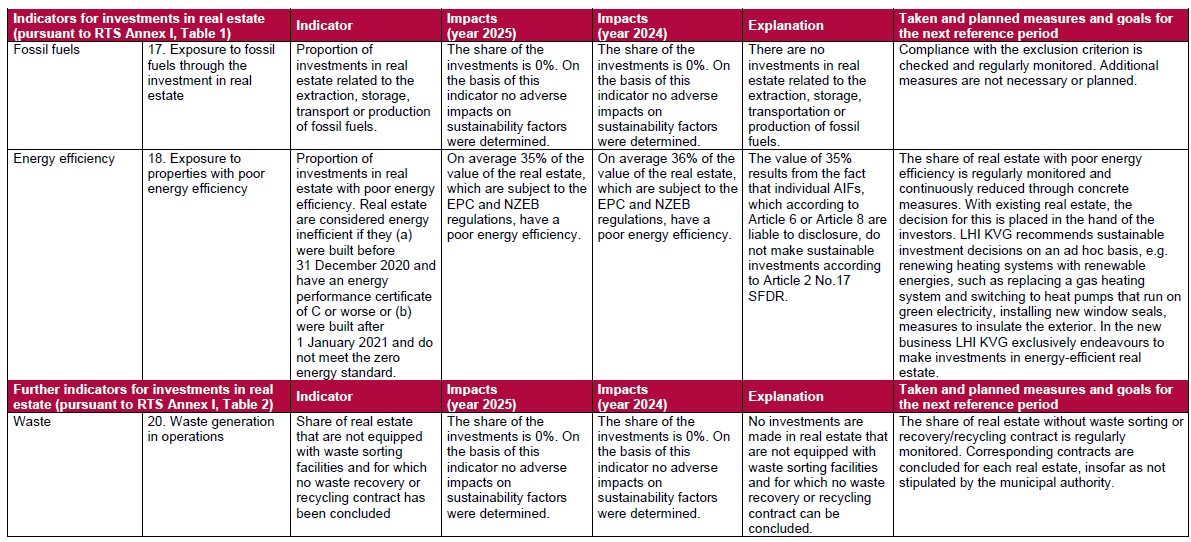
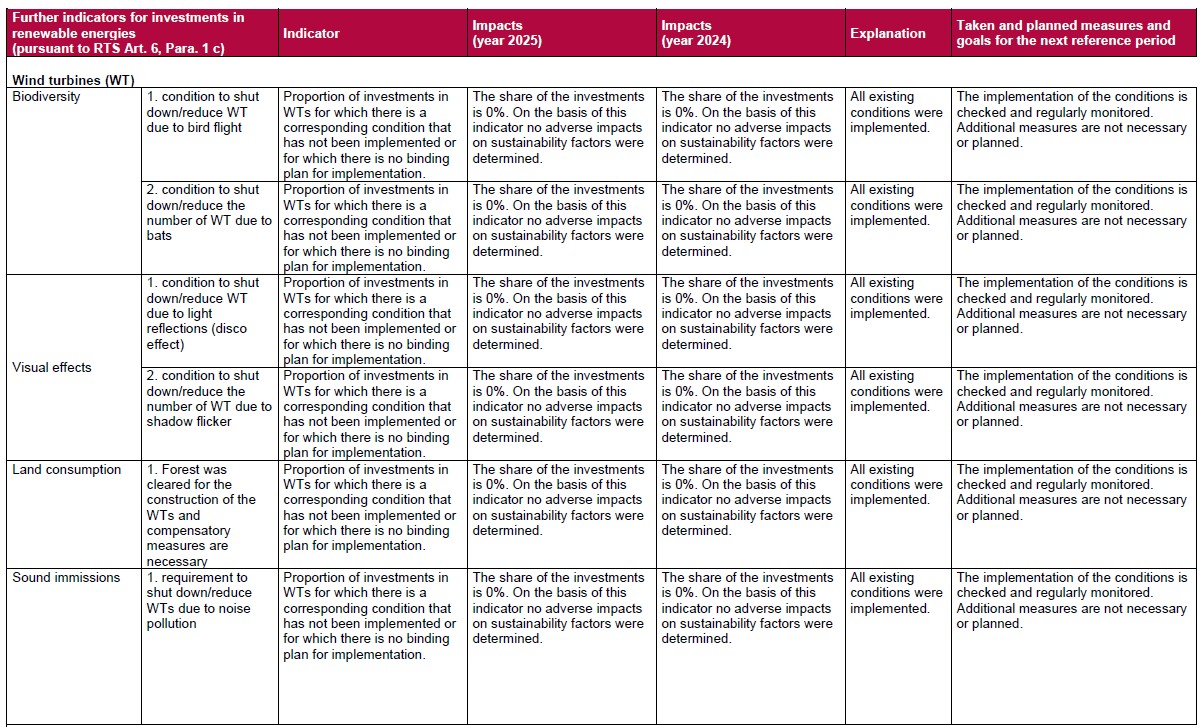
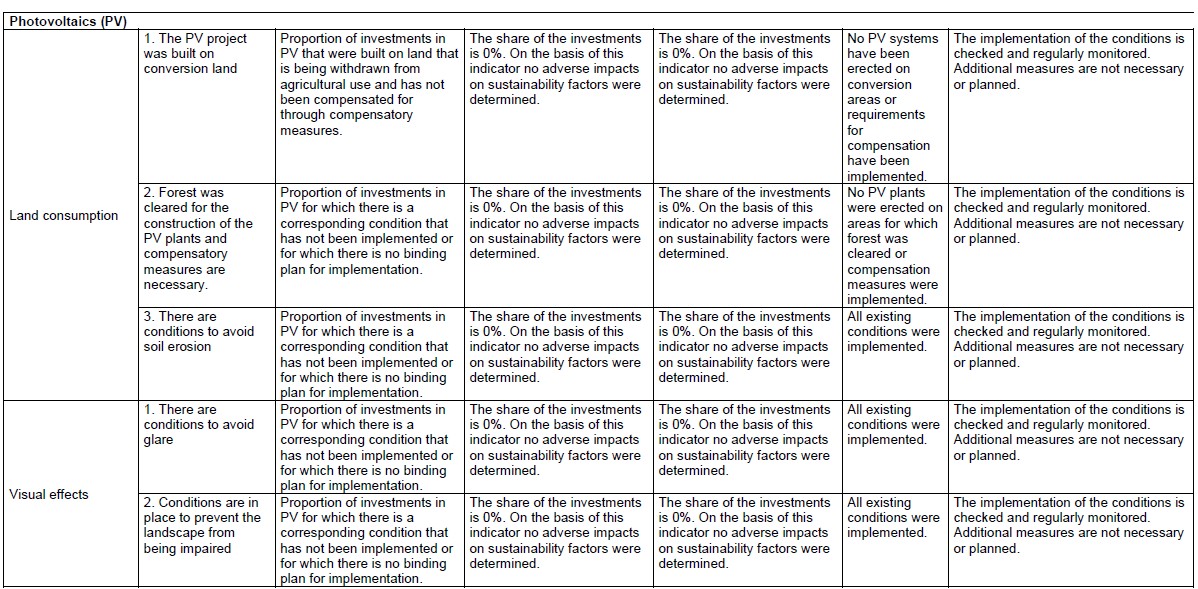
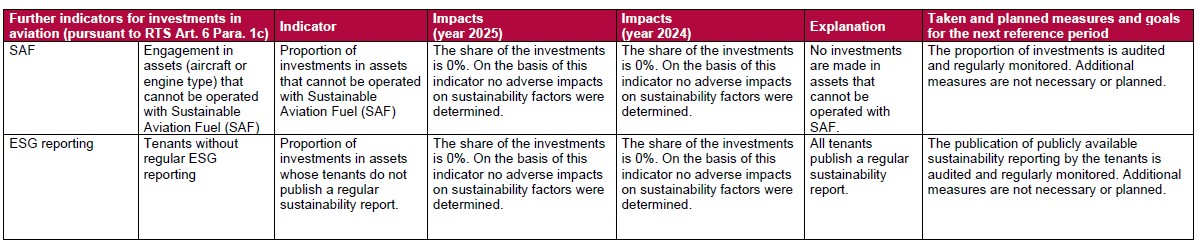
The declaration on the principal adverse impacts of investment decisions on sustainability factors in accordance with Del.VO (EU) 2022/1288 (“RTS”) to the EU Disclosure Regulation of the KVG is available on the website as a pdf for the first time for the 2022 reporting period. The following mandatory and optional indicators for determining and weighting the most important adverse sustainability impacts (“PAI” = Principle Adverse Impactcriteria) are relevant for the KVG:
 “Declaration on the consideration of the main adverse impacts on sustainability factors in investment advice”
You are currently viewing a placeholder content from Vimeo. To access the actual content, click the button below. Please note that doing so will share data with third-party providers.
More InformationYou are currently viewing a placeholder content from YouTube. To access the actual content, click the button below. Please note that doing so will share data with third-party providers.
More InformationYou need to load content from reCAPTCHA to submit the form. Please note that doing so will share data with third-party providers.
More InformationYou are currently viewing a placeholder content from Google Maps. To access the actual content, click the button below. Please note that doing so will share data with third-party providers.
More InformationYou are currently viewing a placeholder content from Google Maps. To access the actual content, click the button below. Please note that doing so will share data with third-party providers.
More InformationYou are currently viewing a placeholder content from Mapbox. To access the actual content, click the button below. Please note that doing so will share data with third-party providers.
More InformationYou are currently viewing a placeholder content from OpenStreetMap. To access the actual content, click the button below. Please note that doing so will share data with third-party providers.
More Information


